
|
An
addiction is a recurring compulsion by an individual
to engage in some specific activity. The term is often
reserved for drug addictions but it is sometimes applied
to other scenarios, such as problem gambling and compulsive
overeating. Factors that have been suggested as causes
of addiction include genetic, biological/pharmacological
and social factors
Physical
dependence on a substance is defined by the appearance
of characteristic withdrawal symptoms when the substance
or behavior is suddenly discontinued. While opioids,
benzodiazepines, barbiturates, alcohol and nicotine
are all well known for their ability to induce physical
dependence, other categories of substances share this
property and are not considered addictive: cortisone,
beta-blockers and most antidepressants are examples.
So, while physical dependency can be a major factor
in the psychology of addiction and most often becomes
a primary motivator in the continuation of an addiction,
the initial primary attribute of an addictive substance
is usually its ability to induce pleasure, although
with continued use the goal is not so much to induce
pleasure as it is to relieve the anxiety caused by
the absence of a given addictive substance, causing
it to become used compulsively.

Don't
Smoke ?,,we all know somebody who does, help
save a life of illness or premature death
send this to a friend |
|
The desire to stop smoking
Many smokers continue smoking
not through free choice but because they are addicted
to cigarettes. A large part of this addiction arises
from dependence on nicotine delivered rapidly to
the brain with each puff. A report by the Royal
College of Physicians found that nicotine complied
with the established criteria for defining an addictive
substance. [1] (For further information
see ASH factsheet: Nicotine
and addiction ) Addiction does not mean that it
is impossibl e to stop doing something, it just
means that there are powerful urges and needs that
have to be overcome in order to do so. Anything
that can strengthen the resolve to resist these
urges and needs or reduce their frequency or intensity
can help in overcoming the addiction.
The large majority of smokers
report that they want to stop.[2] Almost
nine out of ten (88%) of smokers state that they
want to quit because of a health concern. After
health reasons, the next most common reason given
for wanting to give up is a financial one. 2 Probably around half of all smokers make
at least one attempt to stop in a given year [3] but only about 2-3% of smokers succeed long term. [4] It is
not clear why some attempts to stop succeed and
others do not: smoking fewer cigarettes per day,
not needing to smoke first thing in the morning
and not suffering from mental health problems, or
other addictions are favorable signs.
Beneficial health changes when you stop smoking
Stopping smoking is always urgent but never too late.
Every cigarette smoked damages the lungs in a way
that may not show up until later in life. After
the age of 35-40 years every year of continued smoking
loses 3 months of life expectancy.[5] Many
smokers think that they will be more miserable when
they stop but actually all the evidence is that
they will have better mental health [6] and be happier. [7]
Some of the health benefits from stopping smoking
can occur quite quickly as the table below shows.
Other health improvements may take many years, depending
on how long a person has smoked. [8]

|
Time since quitting
|
Beneficial health changes that take
place
|
|
8 hours
|
Nicotine and carbon monoxide levels in blood reduce
by half, oxygen levels return to normal. Circulation
improves.
|
|
24 hours
|
Carbon monoxide and nicotine eliminated from the
body.
|
|
48 hours
|
The decline in lung function and excess risk of
lung cancer halts.
|
|
1 month
|
Appearance improves - skin loses its grayish pallor
and becomes less wrinkled
|
|
3 - 9 months
|
Coughs and wheezing declines
|
|
1 year
|
The excess risk of a heart attack reduces by half
compared to that of a smoker.
|
|
15 years
|
Risk of heart attack falls to the same as someone
who has never smoked.
|

Withdrawal symptoms
Withdrawal symptoms are the physical and
mental changes that occur following interruption
or termination of drug use. They are normally temporary
and are a product of the physical or psychological
adaptation to long-term drug use, requiring a period
of re-adjustment when the drug is no longer ingested.
In the case of smoking, some of these are: [9]
|
Withdrawal symptom
|
Duration
|
Proportion of those trying to quit who
are affected
|
|
Irritability / aggression
|
Less than 4 weeks
|
50%
|
|
Depression
|
Less than 4 weeks
|
60%
|
|
Restlessness
|
Less than 4 weeks
|
60%
|
|
Poor concentration
|
Less than 2 weeks
|
60%
|
|
Increased appetite
|
Greater than 10 weeks
|
70%
|
|
Light-headedness
|
Less than 48 hours
|
10%
|
|
Night-time awakenings
|
Less than 1 week
|
25%
|
|
Craving
|
Greater than 2 weeks
|
70%
|
Don't
Smoke ?,,we all know somebody who does, help save
a life of illness or premature death send this
to a friend |
| Hello again from Iowa,
I would like to thank you for your prompt service
on my order.
The so called, "Black Box," works better than any pill
I have ever
taken to relieve stress related pain. I used it this morning for
about
fifteen minutes, and the effects lasted all day. I think this product
will be very useful just before I go to bed. I think that many
more
people would benefit from this product. Unfortunatly though, the
mind-set of people in the US is to take a pill to solve one's ailements.
Good Luck in the new year!
Best Regards, Joel T. Blum. Cedar Rapids, Iowa USA
|
Weight gain
The possibility of weight gain is often
of particular concern to those who want to give
up smoking. Weight gain is often progressive for
a period of at least a year and, on average, ex-smokers
will gain around 5kg in weight.9 However, this is the weight gain made
without recourse to any special attempts at dieting
or exercise and it presents a minor health risk
when compared to the risk of continued smoking. In
addition, improved lung function and some of the
other health benefits of giving up smoking are likely
to make exercise both easier and more beneficial.
See QUIT's guide to
stopping smoking without putting on weight for further
advice.
| EBooks
 |
Diabetic Safe Recipes
With this collection of Diabetic Safe Diet ebook recipes you shouldn't have any
trouble coming up with something you like and also fits your diabetic diet restrictions.
US $4.99
details
| download
|
 |
Diet Tips
41 page ebook, giving loads of tips on dieting, losing weight, working out and
healthy living.
US $5.99
details
| download
|
 |
Health Bible by Deren Stevens
A great eBook for anyone who wants to learn more about nutrition and fitness,
and written by the Fitness Gold.co.uk founder Deren Stevens. This eBook is
packed full of information and is written without any technical jargon - just
clear and concise information! Covers info on gaining muscle size, effective
weight loss, supplement myths uncovered, improving sexual performance and much
more!
US $3.99
details
| download |
 |
How To Quit Smoking
Have you been wanting to stop smoking, but havent really known the right way
to stop? What if I told you that within a week from starting this one stop
smoking programme you could be smoke free forever? It's really not as hard
as you may think.
US $4.99
details
| download |

For most smokers, there is more than one reason
why they smoke. Nicotine addiction is just one
part of the habit. We also develop a behavioral
or psychological addiction as well. Certain feelings,
times of the day or activities all become strong
cues and make us crave a cigarette.
|
Withdrawal Symptoms
Since addiction, withdrawal, are the
result of insufficient levels of certain brain chemicals,
or undeveloped pleasure centers and pleasure pathways,
the most direct way of eliminating them is to restore
optimal levels of the brain chemicals, to stimulate
the pleasure centers and pleasure pathways. One of
the most exciting breakthroughs in the treatment of
addiction has been the discovery that stimulating
the brain with a minuscule electrical current (cranial
electrostimulation, or CES) can cause the brain quickly
to pour out large quantities of the neurochemicals
that have been suppressed by addictive substances.
As electrotherapy researcher Bob Beck
described , this was originally discovered
when scientists analyzed the brains of rats that had
been addicted to opiates: The rats that were addicted
had been getting so much opiate that the little endorphin
factories in the brain would shut down and say, "Look,
our body’s got too much of this. Quit manufacturing
it." And it would take anywhere from a week to
three weeks before their rats’ brains would
begin manufacturing beta–endorphin again. Whereas
in the brains of the control rats that had never been
addicted, you would find the normal, expected levels
of beta–endorphin. And then they would take
a third group of addicted rats, cold turkey cut them
off of the heroin, clip little electrodes to their
ears, and within 20 minutes of electrical stimulation … the
rat brain would start showing that the endorphin production
had started up again. So, those rats wouldn’t
go through withdrawal symptoms!
This evidence quickly led to
the use of CES in the treatment of humans. …
I smoked 40-60 a day for 10 years,,i tried
to give up so many times,each time i would last
for a few days,and once i got to a week,but i
guess i was just weak,:(
My partner bought me a BT9 and to cut a long story
short i had given up within 10 days and had no withdrawal
symptoms,and i hav"nt smoked since..
Thank guys
Kathy
NZ
Ps i lent the unit to my mum who has also given
up |
Reference
to Dr.
Meg Patterson: "Scottish
surgeon Margaret Patterson studied Wen’s methods
in Hong Kong. Back in England she developed highly
sophisticated machines tha tproduced neurotransmitters
by electrostimulation of the brain. Then she set up
her own treatment center in California. J Famous clients
were flown in, some on stretchers – rock superstar
Peter
Townshend for one, guitarist and composer for
The Who and creator of the hit rock musical Tommy.
A drug addict for years, Townshend had spent a fortune
trying to kick his hgabit. Within forty minutes of
applying the device, the heroin was counteracted.
Ten days of treatments later he was over his addiction
to heroin, alchohol, and cocaine, with no withdrawal
symptoms." Page 204
Robert
(Bob) C. Beck, D.Sc. conducted brain research and
developed an improved EEG to read brain wave patterns
in the 1970’s. When he read in 1983 about Dr.
Meg Patterson’s success in helping rock star
Peter Townshend overcome his drug addiction using
a "Black Box Brain Tuner" he contacted her.
These two research pioneers enjoyed several meetings.
Patterson was committed to a large corporation so
Bob Beck decided to develop his own Brain Tuner. With
Bob’s genius, he was able to develop a unit
that emitted all the key frequencies simultaneously.
These frequencies include a special healing frequency
Bob discovered from Russian researchers.
Hence
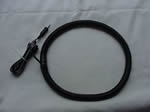
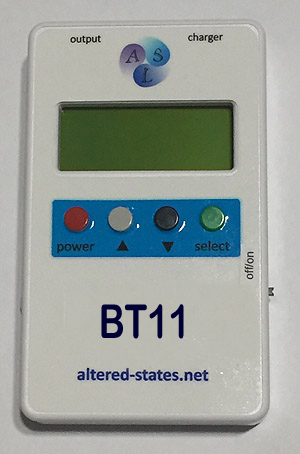
we have the BT9,
THE
BT9 TUNER - or Neural Electric Transmitter/CES
This Electro-Magnetic device puts out a very weak, pulsing signal. When
turned on the signal radiates in all directions. Held close the body's
EM nerve system picks up the signal and responds or resonates to it very
weakly. Body response is 708 stronger if the contacts or electrodes are
touching the body anywhere. The whole system responds to the signal.
However, it is reasonable or logical to apply the contacts
to the local area of the body causing pain or trouble
-- though thousands of years of use of Acupuncture in
the Orient has proven that this is not necessarily true.
Because of the interconnecting nerve system -- or Meridians
as they are called -- treatment in one part of the body
can affect other parts. In modern times the weak, pulsed
eletro-magnetic signal has replaced the twirling or
vibrating of the gold and silver needles of Acupuncture.
Affectiveness of the NET or Brain Tuner device was
established by a Chinese Acupuncturist, Dr. Wen, in
Hong Kong in the 1970s by testing hundreds of patients
at a clinic, most of whom were on drugs of one kind
or another, alcohol, nicotine, heroin, etc, consciously
or unconsciously trying to relieve stress, largely a
mental condition?
It seems that the body -- or Brain -- gives up making
its own pain-killers, Endorphins, when a person turns
to drugs; but putting a weak EM signal into the; body,
especially the head area, stimulates the brain into
producing Endorphins again. Amazingly, the craving for
the drug disappears in three of ten days and without
withdrawal symptoms!
Dr. Wen found through experimentation that the most
favorable place for the electrodes or contacts was the
hollows under the ears. The EM signal does not have
to be felt by the subject or patient, though in some
devices with power controls the current can be turned
up to where a slight tingle is felt. A stronger connection
can be made if the contacts are moistened. They can
be placed on other parts of the body if local treatment
is desired there.

The clinical approach is 15 or 20 minutes per treatment,
once a day. Those office visits are important to a doctor.
But a person with his or her own NET/CES or Tuner can
treat themselves as often as needed -- though a person
should keep in mind that body cells react immediately
to minute pulses of electric current and one can have
too much of a good thing. Probably the most important
part of treatment is the intention of the user. Do you
really want to change yourself for the better?
Hence we have the BT9,small
portable,and best of all it has worked for many

 More
info
|
Refernces
[1] Nicotine Addiction in Britain. A report
of the Royal College of Physicians, February
2000 [View report]
[3] West R (2006) Smoking and smoking cessation
in England: 2006. [View report]
[4] West R (2006) Background smoking cessation
rates in England: [View report]
[5] Doll R, Peto R, Wheatley K, Gray R, Sutherland
I. Mortality in relation to smoking: 40 years'
observations on male British doctors. BMJ 1994;
309: 901-911[Abstract/]
[6] West R, Jarvis M. Tobacco smoking and mental
disorder. Italian Journal of Psychiatry and
Behavioural Science 2005;15:10-17.
[8] The Health Benefits of Smoking Cessation: A report of the Surgeon
General. US
DHHS, 1990.
[9] West, R. and Shiffman,
S. Smoking cessation. Fast Facts. Oxford,
Health Press, 2004
[10] Cigars: Health effects and trends. National Cancer Institute, 1998
[11] Nicotine replacement therapy for smoking cessation. The Cochrane
Library, Issue 3, May 2001 [View abstract]
[12] Bupropion to aid smoking cessation. Drug and Therapeutics Bulletin.
Vol 38 no.10 Oct. 2000
[13] Cahill K, Stead L, Lancaster , T. Nicotine
receptor partial agonists for smoking cessation.
(Review) The Cochrane Collaboration. Art. No.: CD006103. DOI: 10.1002/14651858.CD006103.pub2. View abstract
[14] Stead LF, Lancaster T. Group behaviour
therapy programmes for smoking cessation.
Cochrane Database of Systematic Reviews 2005,
Issue 2. Art. No.: CD001007. DOI: 10.1002/14651858.CD001007.pub2.
[15] Lancaster T, Stead
LF. Physician advice for smoking cessation.
Cochrane Database of Systematic Reviews 2004,
Issue 4. Art. No.: CD000165. DOI: 10.1002/14651858.CD000165.pub2.
[16] Stead LF, Perera R, Lancaster T. Telephone
counselling for smoking cessation. Cochrane
Database of Systematic Reviews 2006, Issue
3. Art. No.: CD002850. DOI: 10.1002/14651858.CD002850.pub2.
|