|
Allergies are very common and affect about
one in three at some time in their lives. There are many
different causes of allergy, and symptoms range from very
mild to potentially life threatening. Allergy is one of the
major factors associated with the cause of and persistence
of asthma.

An allergy occurs when a person’s
immune system over-reacts to substances — called
an allergen — in the environment. These allergens
are found in house dust mites, pets, pollen, foods, drugs,
insect stings, latex and moulds. An allergen for one person
may not be a problem for another person, and everyone reacts
differently.
Do you get recurring problems like joint and
muscle pains, restless legs, fatigue, headaches,
tics, rashes, depression, anxiety, tinnitus . Do
you feel tired after a full night's sleep Do you
feel as if you've never totally been yourself.Do
you frequently have stomach problems - wind, indigestion,
constipation and/or diarrhea?. Have you had bouts
of anxiety, nervousness or depression
for no apparent reason?
Has a doctor, more than once, told you he
can find nothing wrong or that there's nothing
to worry about saying that the rash, pain, (or
whatever) will go away even though you've told
him it recurs, or suggested your problem is stress
related when you know it isn't?
The more questions you have answered YES to, the
greater the likelihood that something you are eating
or in your enviroment is Giving you allergic reactions..
Now you can test
your foods etc,,,See below |
Medical professionals are not sure why some
people develop allergies and others do not, but they found
that the environment and both genes play a role in the
development of certain allergies.
"Health professionals are
concerned that a worldwide rise in allergies and
a shortage
of trained specialists
has left many perople struggling to cope." |
According to the
NLM and the National Institute of Allergy and Infectious
Diseases, Allergies occur as "false
alarms" in the natural defense system of the body.
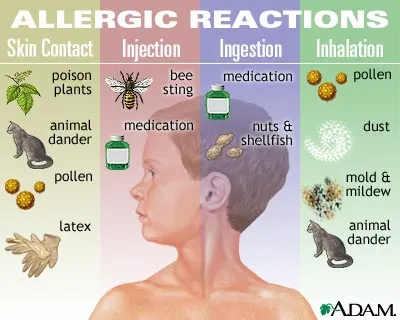
What happens when you have
an allergic reaction?
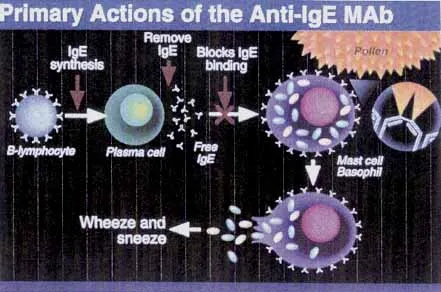
Antibodies are supposed to protect our bodies against viruses, parasites
and infections. But for people with an allergy, their immune system mistakenly
identifies the particular allergen as an invader and begins to create
antibodies against it. These antibodies, called IgE, attach themselves
to mast cells, which are abundant under the surface of the skin and in
the nose, eyes, lungs and gastrointestinal tract. When the allergen is
encountered, the IgE antibodies grab it, triggering the mast cells to
release powerful chemicals, including histamine. This causes the allergic
reaction. A reaction often occurs within minutes or up to a few hours
after contact and may lead to many different symptoms.
A rough explanation of allergies is that any substance
in the air, water, food, or through physical contact can
act as a 'foreign object' in the body. The body then produces
anti-bodies to neutralize or help rid the body of the foreign
substance. In the process, histamine and other chemicals
are released which cause allergic symptoms.
Food Allergies
Food allergies or food intolerances affect nearly everyone
at some point. People often have an unpleasant reaction
to something they ate and wonder if they have a food
allergy.
Seasonal Allergies
Spring is the time of year that we normally think of when
it comes to seasonal allergies. As the trees start to bloom
and the pollen gets airborne, allergy sufferers begin their
annual ritual of sniffling and sneezing.
Pet Allergies
For a person with dog allergies, life in a dog-loving country
isn't easy. Nearly 40% of U.S. households have a dog. Dog
dander gets everywhere, including places where dogs have
never set a paw
Other Allergies
Test Yourself |
Hives (Urticaria) |
Drug Allergy |
Mold Allergy |
Hay Fever |
Pollen Allergies |
Allergic Conjunctivitis (Pink Eye) |
Sun Reactions of the Skin |
Allergies to Poison Ivy, Oak, and Sumac |
Cosmetic Allergy |
Allergies to Insect Stings (Bee Stings) |
Nickel Allergy |
Aspirin Allergy (Salicylate Allergy) |
Dust Allergy |
Chemical Allergy |
Penicillin Allergy |
Wheat Allergy |
|
If you suspect that you have an allergy, Mucle
testing can often quickly identify what is triggering
your allergic reaction and causing your symptoms. |
Often allergic symptoms are good in that the body seeks
to expel the offending substance. Sneezing or coughing
when you breathe dust, for example, is a normal reaction
of the body. If, however, the normal defense mechanisms
malfunction or become extra-sensitive, the reaction can
become prolonged or excessive.

"What
is food for one, is to others bitter poison" Lucretius
Muscle Testing:
The Truth in the palm of your hand!
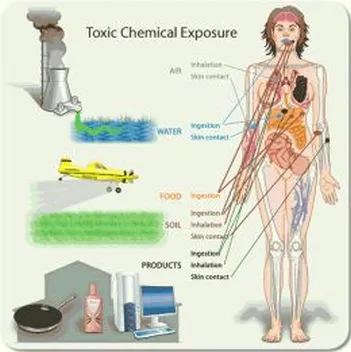
Allergic reactions are as diverse as the
person themselves; however, more and more people are developing
severe allergies as a result of living in a toxic world.
"Destroy a man's
mind, his reasoning ability, his imagination, and
neither gold, silver, mansions, freedom, love nor
anything else will matter to him. This is EASILY
ACCOMPLISHED, is BEING ACCOMPLISHED by simple means:
the creation of disease in his body by Toxic substances
in his food; shattering his nervous system, hardening
his muscles, and deteriorating his mind; making
of man, the godly human, a sub-human creature,
a lesser animal, a vegetation, Soulless"- The
Crime Against Humanity. R. S. Clymer, M.D., 1945 |
"Synthetic chemicals
are all around us. They're in the products we use, the clothes
we wear, the bedding we sleep on, the food we eat, the air
we breathe, the medications we consume. Because chemicals
are everywhere, it's impossible to completely escape exposure.
These environmental allergens are life-changing, and often
life-destroying, for the person afflicted and those around
them. The resulting allergic reactions affect not only the
way our body functions, but the physical, sociological, and
emotional quality of life as well." Dr. Gloria Gilbere
The causes of allergies involve one or more of the following
mechanisms in most cases:
 · Weak
adrenal glands and low cortisol and cortisone production.
Cortisol, cortisone and adrenalin stop allergic reactions. · Weak
adrenal glands and low cortisol and cortisone production.
Cortisol, cortisone and adrenalin stop allergic reactions.
· Excessive
cell permeability, mostly in fast oxidizers.
· Fatigue
or stress from any causes, which affect many systems
of the body, notably the adrenal glands.
· Weakened
capillaries leading to capillary fragility. This has to
do with copper imbalance, vitamin deficiencies such as
vitamin C, and a need for substances such as bioflavinoids.
· Impaired
quality of certain mucus membranes, which opens the body to penetration
by foreign proteins.
· Other
nutrient deficiencies or toxic metals such as mercury,
lead and others.
· Food
allergies are often due to the presence of candida albicans
· Toxic
Enviroments
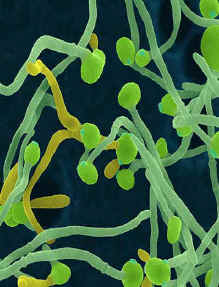
Candida albicans is a dimorphic fungus that
causes severe opportunistic infections in humans.
Recent advances in molecular biology techniques
applied to this organism (transformation systems,
gene disruption strategies, new reporter systems,
regulatable promoters) allow a better knowledge
of both the molecular basis of dimorphism and
the role of specific genes in Candida morphogenesis.
These same molecular approaches together with
the development of appropriate experimental animal
models to analyze the virulence of particular
mutants, may help to understand the molecular
basis of Candida virulence.More
Fight Candida
albicans |
or other infections that cause “leaky gut syndrome”.
Chemicals in foods and improper diet also commonly cause
food reactions and can damage the intestines.

Are you allergic
to your meds?
Now you can TEST
Toxins
Most people today have excess accumulation of toxins and waste material
in their bodies causing their body to be acidic and adding stress to
their immune system function.When toxins are allowed to accumulate,
they cause the immune system to be suppressed, and the body becomes
acidic. Accumulated toxins that have not been flushed out or eliminated
allow the body to create an environment where illness and disease can
flourish.
Dehydration causes a weak
immune system
Dehydration means the cells just simply do not have enough fluid. Dehydration
cause medical problems including pain, arthritis, asthma, and allergies,
among other medical issues. It can affect your energy and your sleep,
and the ability to get toxins/waste material out of the body.
Emotions have
powerful effects on glandular activity. Fear, worry, anger
and other negative emotions add stress to the body. Positive,
inspiring, uplifting thoughts reduce stress.
Chronic infections such
as candida albicans, infected teeth, ear or sinus
infections weaken the body and must be eliminated
to stop some allergies. Fungi/Parsite
protocol
Detoxification.
This is often a key aspect of a complete healing program. Ionic
Detox Units

Stress Reduction.Unfortunately,
stress is common place in many peoples lives and responding
wrongly to chronic (long term) stress will suppress your
immune system. Reducing stress usually helps allergies
a lot. Stress may come from many sources from within and
without the body. When it reaches a certain level, the
adrenals can no longer respond properly and allergies result.
For this reason, any therapy or activity that reduces stress
from any source may reduce allergies. Here
are some Suggestions for Reducing Stress
Obesity can lead to a weak immune system.
It can affect the ability of white blood cells to multiply,
produce antibodies, and rush to the site of an infection.
Excess alcohol produce a weak immune system
Excessive alcohol intake can harm the body's immune system in two ways.
First, it produces an overall nutritional deficiency, depriving the
body of valuable immune- boosting nutrients. Second, alcohol, like
sugar, consumed in excess can reduce the ability of white cells to
kill germs. High doses of alcohol suppress the ability of the white
blood cells to multiply, inhibit the action of killer white cells on
cancer cells, and lessen the ability of macrophages to produce tumor
necrosis factors. One drink (the equivalent of 12 ounces of beer, 5
ounces of wine, or 1 ounces of hard liquor) does not appear to bother
the immune system, but three or more drinks do. Damage to the immune
system increases in proportion to the quantity of alcohol consumed.
Amounts of alcohol that are enough to cause intoxication are also enough
to suppress immunity.Stop Drugs
If your body is under stress from illness,
a compromised immune system, or continued exposure
to toxins, it can become over-burdened and more reactive
to things that under more optimum circumstances would
not bother you. Limiting exposure to foods and substances
that weaken you is important for creating an environment
in which your body's natural healing process can
do its work.
Reducing
Stress |
"Let
thy food be thy medicine and thy medicine by thy food" Hippocrates

GENERAL INFORMATION
Most people who have true allergies know it – their eyes itch,
they sneeze, or break out in a rash. Sensitivities or intolerances can
be more difficult to detect as the symptoms are less obvious and sometimes
don’t appear until a while after exposure. Allergies and chronic
sensitivities can be the cause of many illnesses, including headaches,
digestive disorders, PMS, respiratory and skin problems, arthritis, chronic
fatigue syndrome, obesity, and mood disorders.

Food intolerance or sensitivity is more widespread and
it is estimated that up to 20% of the population are affected,
many who have no idea that food is the underlying cause
of their illness. It is a digestive system response, and
does not involve the immune system. An example would be
lactose intolerance - this is when your body lacks the
enzymes needed to digest products which contain lactose,
as in milk, which can cause uncomfortable symtoms such
as bloating, gas, etc. General symptoms of food sensitivities
can range from cramps, bloating and nausea or diarrhea,
to headaches or general malaise.
TESTING FOR
ALLERGIES
Applied kinesiology (AK) is the term most commonly used
to identify a system of muscle-testing and therapy. It
was initiated in 1964 by George J. Goodheart, Jr., D.C.
(1918-2008) and has become quite elaborate. Its basic notion
is that every organ dysfunction is accompanied by a specific
muscle weakness, which enables diseases to be diagnosed
through muscle-testing procedures. Most practitioners are
chiropractors, but naturopaths, medical doctors, dentists,
nutritionists, physical therapists, massage therapists,and
nurse practitioners, . In 1991, 37% of 4,835 full-time
American chiropractors who responded to a survey by the
National Board of Chiropractic Examiners (NBCE) said they
used Applied kinesiology in their practice [1]. Subsequent
NBCE surveys found percentages of 31% in Canada (1992)
[2], 60% in Australia (1993) [3], 72% in New Zealand (1993)
[3], 43% in the United States (1998) [4], and 37.6% in
2003 [5].
Dr George Goodheart, a Chiropractor from Michigan, USA,
developed manual muscle testing further in the 1960s by
elucidating the relationship between specific muscles and
organs, glands and meridians. The system of diagnosis and
correction he developed based on muscle testing he called
Applied Kinesiology (A.K.). Indeed, it was from A.K. that
all other types of Kinesiology developed. Since John Thie
developed Touch for Health in the early 1970s (2), the
art of muscle testing has been taught to thousands of lay
people. Several of these people then went on to develop
various other forms of Kinesiology (One Brain Kinesiology,
Educational Kinesiology, Biokinesiology and Applied Physiology
to name but a few) (3).
What is muscle testing? Sounds a simple enough question
that I'm sure most of you have heard before. You may have
found, however, that the answer was not so easy to come
up with! You may answer that a positive muscle test is
one in which the muscle being tested is "strong" and
a negative muscle test is one in which the muscle being
tested is "weak". But what does a muscle being
strong or weak mean? Below is an explanation of muscle
testing and how much information just testing a single
muscle can give.
Muscle testing as employed in Touch for Health (TFH)
and other types of Kinesiology originated with Kendall
and Kendall, two academic kinesiologists in the late 1940s
(1). They developed test positions for a number of muscles
of the limbs and trunk that isolated, as much as possible,
the action of one muscle in contraction as "prime
mover" - the muscle with the optimal mechanical advantage
in that position. By applying manual pressure to the limb
or other body part in that test position, the integrity
of response of that "prime mover" could be evaluated.
If the muscle could not resist the pressure, indicating
loss of full neurological integrity, they developed a relative
scale from 0, or no resistance (flaccid paralysis) to 5+,
or full lock.
Are you Allergic to your
pets?
On
the Reliability and Validity of Manual Muscle Testing:
Muscle Testing is a simple process that
can be helpful in identifying foods which do not agree
with your body. Any food or supplement can be easily tested
to ensure that it is something that will strengthen and
is compatible with your body...and help you to know which
foods are weakening you and that you should avoid. The
Muscle Testing link above will bring you very good information, but
essentially muscle testing works by holding the food/item
close to the body (chest area) and testing the impact this
has on your overall muscle strenth. When
something is compatible your muscles remain strong, when
it does not agree with you it will be very apparent because
you will experience muscle weakness.
"When your body Agrees it is strengthened
and when it dissagrees it is weakened"
Applied kinesiology proponents claim that nutritional
deficiencies, allergies, and other adverse reactions to
foods or nutrients can be detected by having the patient
chew or suck on these items or by placing them on the tongue
so that the patient salivates. Some practitioners advise
that the test material merely be held in the patient's
hand or placed on another part of the body. According to
a 1987 book for the general public written with help from
two leading chiropractic AK practitioners:
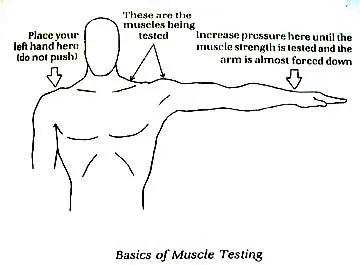
Many muscle-testing proponents assert that nutrients tested
in these various ways will have an immediate effect: "good" substances
will make specific muscles stronger, whereas "bad" substances
will cause weaknesses that "indicate trouble with
the organ or other tissue on the same nerve, vascular,
nutrition, etc., grouping." A leading AK text, for
example, states:
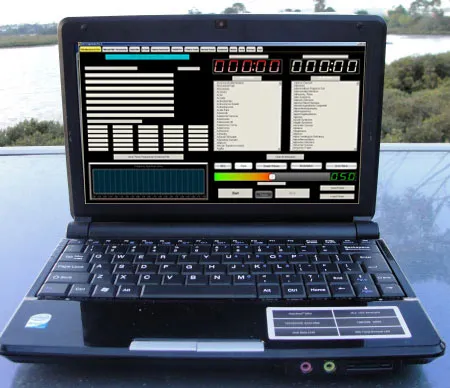
Now you can Muscle test Electronically
 |
Sweep / Step Generator
You can use the Sweep Generator for finding your own
frequencies cells, Allergies, bacteria and other organisms
like bed bugs etc... Usually the Sweep Generator is
used
while observing cells under a microscope. If you have
a USB or dark field microscope, you can monitor results
unattended.
You can also use the Sweep Generator in a Holistic
fashion using muscle testing. Some use it simply to
find "feel good"and Allergy frequencies,
as some believe that the body (mind) naturally knows
the
frequencies
it needs. These frequencies can be logged and saved
to presets in Rife Pro. More information
|
The Rife pro has a full muscle testing program
If a patient is diagnosed as having a liver disturbance
and the associated pectoralis major [chest muscle] tests
weak, have the patient chew a substance that may help the
liver, such as vitamin A. If . . . the vitamin A is appropriate
treatment, the muscle will test strong
 |
Muscle
Tester
Simply Squeeze to test your Muscle Strength
Full instructions
|
On
the Reliability and Validity of Manual Muscle Testing:
Weakness and fatigue are terms
that are often used as if they mean the same thing,
but in fact
they describe two different sensations. It is important
to know exactly what you mean when you say "I
feel weak" or "I am fatigued" because
it can help you and your doctor narrow down the
possible causes of your symptoms.
Weakness is a lack of physical or muscle strength
and the feeling that extra effort is needed to
perform daily activities that require you to
move your arms, legs, or other muscles.
Fatigue is a feeling of tiredness, exhaustion, or lack of energy.
Both weakness and fatigue are symptoms, not diseases. Because these
symptoms can be caused by many other health problems, the importance
of weakness and fatigue can only be determined when other symptoms
are evaluated.
Muscle weakness that is slowly getting worse requires
a visit to a doctor.
Sudden muscle weakness and loss of function in
one area of the body can indicate a serious problem
within the brain (such as a stroke or transient
ischemic attack) or spinal cord or with a specific
nerve in the body.
Source |
Finding a "weak" muscle " Some
practitioners contend that muscle-testing can also help
diagnose allergies and other adverse reactions to foods.
According to this theory, when a muscle tests "weak," the
provocative substance is bad for the patient. Applied kinesiology"treatment" may
include special diets, food supplements, acupressure (finger
pressure on various parts of the body), and spinal manipulation
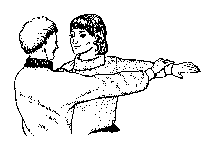
Goodheart states that Applied kinesiology techniques can
also be used to evaluate nerve, vascular, and lymphatic
systems; the body's nutritional state; the flow of "energy" along "acupuncture
meridians"; and "cerebro spinal fluid function." The
70-page chapter on "meridian therapy" in a leading
Applied kinesiology textbook advises that subluxations
influence the status of meridian system and vice versa
=
Applied
Kinesiology
The leading publisher/distributor
of AK educational materials for chiropractors and
their patients appears to be Systems DC, of Pueblo,
Colorado. Its pamphlet on infections and child health
states:
When an infection develops, have your child examined
by your doctor using applied kinesiology. He can
evaluate the energy patterns and usually find the
reason that the infection developed in the first
place. By correcting the energy patterns within
the body and paying specific attention to nutritional
supplements and dietary management, the infection
which your child (using natural health care) does
develop will be adequately taken care of in most
cases |
Some of the most common symptoms of a food allergy
include a constantly runny nose, fluid retention, weight
gain, headaches, skin complaints, arthritis, asthma,
gastrointestinal complaints, menstrual disorders, hypoglycaemia, muscle
weakness,and behavioural problems.More
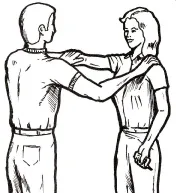
Many muscle-testing proponents assert that nutrients tested
in these ways will have an immediate effect: "good" substances
will make specific muscles stronger, whereas "bad" substances
will cause weaknesses that "indicate trouble with
the organ or other tissue on the same nerve, vascular,
nutrition, etc., grouping."
As you become faster with your testing, you can use it
for deciding what you choose and use during your day. Your
clothes, your foods and beverages, any purchase you are
considering, any choice can be checked to see if the body
is enhanced or diminished energy-wise by a certain selection.
ALLERGY FREE

On
the Reliability and Validity of Manual Muscle Testing:
It has been well established that allergies foods
and toxins cause muscle weekness,,,The basic principle
of muscle testing is" muscle weak" or "muscle
strong",,,now you can test the foods you use and
the toxins in your enviroment by using this muscle strength./weakness
principle...
Your Muscle testing can be used for so much more
 Practice
with Muscle testing makes you a better problem solver. Practice
with Muscle testing makes you a better problem solver.
Kinesiology encourages asking more questions and better questions. Many readers
will appreciate how all science begins with asking good questions. Kinesiology
testing makes asking questions MUCH EASIER and therefore more fun!
Muscle
testing as ‘asking for a direction’
In Kinesiology we don’t test for answers; we test
for a direction (Maryann Castellanos).
Positive responses in Kinesiology testing are best interpreted not so much
as “answers.” Rather responses are best interpreted as, “The
direction is “this way,” keep going this direction.”
Muscle
testing supports and encourages independent thinking,
thinking for yourself.
Many people come to Kinesiology after spending time and
money with conventional medical pathology experts—without
relief. Kinesiology delivers many ways to get your own
answers to the perplexing questions we all have from
time to
time.
Practice
with Muscle testing increases self-confidence.
Practice of Kinesiology opens resourcefulness beyond the isolated thinking
mind, beyond the merely logical-sequential intellect.
Once you learn to test your self, and
once you trust how it works for you,
and you practice in safe areas,
like which movies to see or
which vitamins are beneficial for your body at this time,
your confidence in your growing ability to take care of your needs spreads
out, generalizes,
in larger and larger circles, into your life.
Practice
with Muscle testing supports keeping an open mind.
It’s okay not to know! “You don’t have to know—you
only have to ask” is how Maryann Castellanos puts it.
Most of our body and most of every human psyche lies in the sub- and unconscious.
Any Kinesiology tester understands how little they know—how much is unknown.
Practice
with Muscle testing encourages useful mental-emotional
neutrality.
Kinesiology encourages emotional neutrality when asking
questions. So rather than REACT—we can ask; rather than guess and jump to conclusions—we
can ask
Muscle
testing encourages being a good student, no matter
how old you
are.
Kinesiology encourages asking for second opinions from those who know more
than you do. Your body knows more about how your immune system will respond
to a spicy hot tamale than your rational mind does. Your high self knows more
about whether next Tuesday or next Thursday is the more optimal day for the
meeting.
Muscle
testing proves the possibility of limited, direct communication
with the immune system.
With all the questions possible to ask on any given health challenge, you are
wise to ask the immune system of the body directly. If you wish to hear from
an expert on your body, you HAVE to ask your immune system directly. The immune
system is the expert on your body, not the rational mind.
The
effectiveness of vitamins, drugs, and all other interventions
of any kind can all be estimated (measured) prior to
application.
Testing vitamins:
Which of these store vitamin C brands
work best for my body?
What vitamins from my home vitamin collection does my body want today?
Are more minerals beneficial for my body now?
Kinesiology
Through Muscle testing encourages working with the
Highest Light you can get!
Kinesiology testing encourages working with the Light
of the Highest Good for all concerned. Why? Because
this is the “default setting” for all
beings above the physical. In the astral realm and above awareness of the highest
good is automatic; it’s the air you breathe. You can still ignore it
but you know it’s there With practice, Kinesiology creates access to
your high self.
Muscle
testing is a red carpet rolled out towards healthier
decisions
everywhere in your life. That’s why people who
learn it?and learn to trust their test results--never
give it up
|
Muscle
Tester
Simply Squeeze to test your Muscle Strength
Full instructions
|
Muscle testing is a skill, not an art,
nor yet a science. You are simply doing a natural form
of biofeedback with a machine. With a little practice
most people will soon be able to get results that are
convincing, compelling, and quite exciting. Once this
signalling system is set up, you are ready to ask more
useful questions. |

TESTING FOR
ALLERGIES and TOXICITY
If you suspect that you have an allergy,
Mucle testing can often quickly identify what is triggering
your allergic reaction and causing your symptoms.
One of muscle testing’s greatest
strength is that it allows a person to customize
their herbal
or
health program to account for individual constitutional
differences. Different types of individuals may require
slightly different remedies for the same problem. Some
people may have a rare allergic reaction to certain herbs.
Muscle testing helps screen out these problems.
The fact that a person feels stronger even when holding
certain remedies or being around certain energies, also
makes them more confident that they can get well. |
When in Doubt Muscle test
Nasal congestion
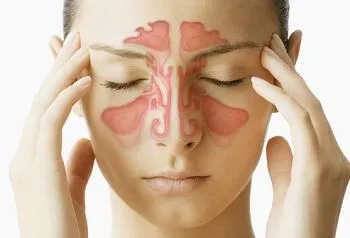
Nasal congestion is the blockage of the nasal passages
usually due to membranes lining the nose becoming swollen
from inflamed blood vessels.[1] It is also known as
nasal blockage, nasal obstruction, blocked nose, stuffy
nose, or plugged nose.
Nasal congestion has many causes and can range from
a mild annoyance to a life-threatening condition
Nasal congestion can interfere with the hearing
and speech. Significant congestion may interfere
with sleep, cause snoring, and can be associated
with sleep apnea. In children, nasal congestion from
enlarged adenoids has caused chronic sleep apnea
with insufficient oxygen levels and hypoxia, as well
as right-sided heart failure. The problem usually
resolves after surgery to remove the adenoids and
tonsils.

Your sinuses are hollow air spaces within the bones
between your eyes, behind your cheekbone, and in
the forehead. They produce mucus, which helps keep
the inside of your nose moist. That, in turn, helps
protect against dust, allergens, and pollutants
Nasal congestion or a " stuffy nose" can
be annoying. Your nose drips and runs; you sound
funny when you talk; and just when you want to blow
your nose to finally breathe again, nothing comes
out. Many people mistakenly think a stuffy nose is
the result of too much mucus in your nasal passages.
A stuffy or clogged nose is actually caused by inflamed
blood vessels in your sinuses. These irritated blood
vessels are usually caused by a cold, the flu, allergies,
or a sinus infection.
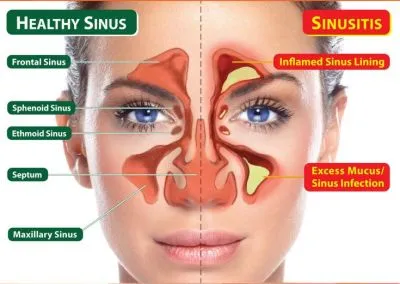
On the surface of things, the cause of sinus trouble
is clear. Teeny holes that connect your nasal passages
to your sinuses (basically a collection of hollow,
moist cavities that lurk beneath your nose, eyes,
and cheeks) get blocked. Then gunk builds up in your
sinuses, germs may grow, and you feel, well, hideous.
Many symptoms of a sinus infections
are common in both acute and chronic forms.
Pain The
most common symptom of sinusitis, and often the
most unpleasant, is pain
Sinus Discharge Pain
from a sinus infection ain't no fun, and
the nasal discharge isn’t that great
.
Congestion At
the same time that you’re dealing with the
drainage, your inflamed sinuses could also be restricting
how well you can breathe through your nose
Headache The
relentless pressure and swelling in your sinuses
can reverberate throughout your skull and leave
you with a massive headaches
Cough As
the discharge from your sinuses drains down the
back of your throat, it can cause plenty of irritation
Sore Throat That
irritating postnasal drip can leave you with a
raw and aching throat.
Lung Infections Are
common during chronic sinus infections
By stopping a sinus infection early, you avoid later symptoms and complications
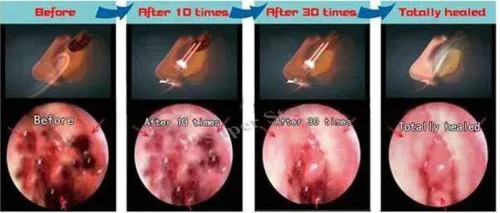
By stopping a sinus infection early,
you avoid later symptoms and complications
" Sinusitis is an inflammation
of the sinuses. It is often caused by bacterial
(germ) infection. Sometimes, viruses
and fungi (molds) cause it. People
with weak immune systems are more likely to develop bacterial
or fungal sinusitis. Some people
with allergies can have "allergic
fungal sinusitis." Acute sinus
disease lasts three to eight weeks. Sinus disease
lasting longer than eight weeks is considered chronic."

Any time you’re unsure
of what’s going on with your health, you
should see your doctor
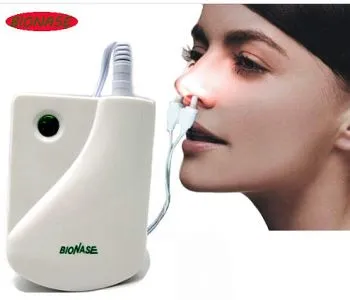
BioNase Sinusitis
Nose Therapy Hay fever Low Frequency infared
therapy
Red is called "The Great Energizer" and "The
Father of Vitality." Red is warm, vital, heating.
It loosens, opens up clogs, releases stiffness and
constrictions. It is excellent for areas that have
become stiffened or constricted.
"INCREASED HEALING IN
THE 660 nm (Red) Wavelerngh
It didn't matter what the frequency was. It could be infrared, red,
blue, or green, as long as it was single although, as you
move toward the red end of the spectrum, the rate
of cellular regeneration increased.
For instance, a single frequency in the green range might affect
the kidney 40 times better than a normal base-line study, whereas
a red would be about 4,000 times faster. So if you
have an injury you would normally recover from in ten days, you can
actually recover that tissue in two days by treating it with light. " |
RED is the first visible colour we see after the
infra-red band is passed. Red is thermal, heating,
warming, yang and positive. It has many tendencies
including the promotion of cellular growth and activity,
stimulating anti imflammitory, and life force,the
circulatory system. It is therefore indicated for
all colds, sluggish or dormant conditions, such as
pneumonia, sinus, hayfever,bursitis, , arthritis,
anaemia, as a liver stimulant, an energy builder,
and increasing circulation
Click on picture
Therapeutic
Effects
Increases
blood capillary circulation and vascular activity
by promoting improvement in the metabolism
of nitric oxide (NO). This facilitates improved
regulation of vasodilation and leads to the
formation of new capillaries - this in turn
provides additional oxygen and nutrients to
accelerate natural tissue healing processes
and eventually evokes a cascade of beneficial
biochemical processes.
Stimulates
synthesis of adenosine tri-phosphate
(ATP)—an immediate energy source
for muscle contraction and essential
in the metabolism of all cellular processes
and sustaining living systems
Relaxes
muscles, reduces nerve excitability and
stimulates nerve transmission
Reduces
scar tissue and stimulates wound healing Stimulates
acupuncture points and immune response
Stimulates
production of collagen—the most important component
of wound healing
Increases
phagocytosis - the body’s natural process to scavenge
dead and degenerated cells and is important to the infection
control process required for healing
Increases
RNA/DNA synthesis - this stimulates cellular reproduction
and facilitates accelerated replacement of damaged cells
Increases
production of endorphins and enkephelins from the brain
- promoting pain reduction and mood elevation
Reduces
inflammation and swelling in chronic conditions
Stimulates
tissue granulation and connective tissue formation
- an important process in the healing of wounds, ulcers
and inflamed tissues
1. Red/infrared is painless, non-invasive, no side
effects and has good, effects.
2.The instrument do not contain pharmaceutical and chemical component.
Red/infrared treatment fundamentally enhance the detoxifying capacity
and immunocompetence
3.It\'s a portable instrument
Red/Infrared
 Red/
Infrared Rihinitis therapeutic apparatus is based
on modern medicine and clinical practice research
and development of semiconductor Red/infrared therapeutic
instrument, the instrument adopts the semiconductor
Light produced wavelength of 660 nm, for irradiation
treatment to the nasal cavity. Red/
Infrared Rihinitis therapeutic apparatus is based
on modern medicine and clinical practice research
and development of semiconductor Red/infrared therapeutic
instrument, the instrument adopts the semiconductor
Light produced wavelength of 660 nm, for irradiation
treatment to the nasal cavity.
Super
low intensity light can also activate certain receptors,
produce photochemical effect,
Principle of treatment:
is
suitable for individual and family therapy and
health care.


|
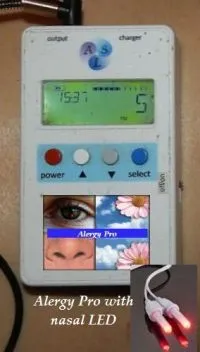
Latest
Allergy Pro
Power Supply Rechargable
Batteries, supplied with Recharger
Timer 10, 20, 60 minutes and continuous
Pulse the laser with these healing frequencies
0.5 Hz. Stress Releas
1.5Hz Allergies Pain
5.00Hz Healing
7.83Hz Healing and Meditation
100.Hz Blast Depression
BT11
Mood and Healing Frequencies
LED Nasal nose piece
Ear Clips
Intensity Control
Timer
Rechargable
Light Weight and fully portable
Instructions
|
|
Muscle
Tester
Simply Squeeze to test your Muscle Strength
Full instructions
|
Click on picture for more Information
|
| |
|
Whatever
is causing your stuffed-up nose, here is possibly
a way
to get your nose unclogged so you can feel—and
breathe—better |
|
Rife
Pro "Installed with computer"
Rife
Pro Fast Presets
|
In 1992, Bruce Tainio of Tainio Technology,
an independent division of Eastern State University
in Cheny, Washington, built the first frequency monitor
in the world. Tainio has determined that the average
frequency of the human body during the daytime is
62-68 Hz. A healthy body frequency is 62-72 Hz .
When the frequency drops, the immune system is compromised.
Check out these very interesting findings:
Human Body:
Genius Brain Frequency 80-82 Hz
Brain Frequency Range 72-90 Hz
Normal Brain Frequency 72 Hz
Human Body 62-78 Hz
Human Body: from Neck up 72-78 Hz
Human Body: from Neck down 60-68 Hz Thyroid and
Parathyroid glands are 62-68Hz
Thymus Gland is 65-68 MHz
Heart is 67-70 Hz
Lungs are 58-65 Hz
Liver is 55-60 Hz
Pancreas is 60-80 Hz
Click here for more information
"Royal rife developed "Five" Rife
machine prototypes ,the fith rife machine(beam ray)was
reported to be the most powerful"
""I can assure you that no one, not even
myself, could help but be astounded at the results
we are now obtaining with the assistance of our new
Rife machines and our new band of MOR's.(Mortal oscillatory
rate)" (Letter from Dr. Johnson to Dr. Gruner
(copy sent to Dr. Rife) dated, November 4, 1936."."
"None of Dr. Rife's previous instruments ever
had the capability that this instrument had.. Dr.
Johnson pointed this fact out in his letter. "The
major difference between this new Rife Ray #5 Clinical
instrument and Dr. Rife’s previous
instruments is the fact that this new instrument
could produce over one hundred harmonic side bands
simultaneously. It was this new harmonic sideband
capability in this Beam Ray Clinical instrument which
makes this sweep we are discussing on this page possible."
The worlds most advanved
multi purpose Fully
Automatic Rife/Hoyland System Read more here
|
|